Maybe it was because the event was sandwiched
between two full moons in July. Or,
perhaps, the sweltering heat – a day so hot that the sidewalks were steaming,
and the windows ran with moisture – was a factor. I can’t be certain. But,
love was certainly a major theme of Summer
Wonder, Bywords’ music and poetry event of July 18, 2004, at Chapters on
Rideau. And, as often happens, the love
theme was diluted with a curious amalgam of disappointment, broken dreams and
even death – in much the same way as heat and summer met up with cold and
winter in several of the poetry readings.
The large crowd that showed up that afternoon left
Chapters’ staff scrambling for more chairs.
After we had settled down, host Amanda Earl read Jack Kerouac’s letter
to his wife, written in 1957, which evokes the magnificent pine, cool, moonlit
nights and “the ecstasy inside . . . to go to places where you learn the lesson
you forgot.” I wondered whether Kerouac
had intended to write a love letter, a philosophical treatise, or both.
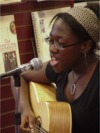
Singer/songwriter Melissa Laveau next took to the
stage; and, although she was introduced as a “hip-hop, blues and folk” artist,
she confessed to being “more folk than hip-hop.” The musical set began with a cover version of the Sonny and Cher
classic, “Bang-Bang”; Laveau’s interpretation was less decorative, yet more
plaintive and ardent, than the original.
The singer dedicated her next piece, “Stones,” “to Amanda, who likes the
song.” The song, a petition to an
indifferent beloved, features some elaborate and melodious guitar work. Laveau’s often complex lyrical patterns (“I
could swallow the ocean” and “you wouldn’t turn around”) were deftly executed,
and she was confident and in command of her material. “Familiar” kept up the theme of the uncaring lover by charting
the fruitless nature of the quest – “Trying to unuse myself to you / Breaking
habits because they’ve broken me through” – to the recognition that “Your name
no longer rolls on my tongue / It’s lost its graces.”

Asoka Weerasinghe, the award-winning poet and
co-founder of “Gloucester Spoken Art,” was the first to present. He read “That Weekend,” and “Mumbles,” both
of which are featured in the Summer 2004 issue of the Bywords Quarterly
Journal. The implicit longing, so
subtly presented in the former, was in contrast with the explicit sensuality of
the latter: “I kiss your mouth garnished / by the dampara-mango juice.” In a reflection of the speaker’s ardor, the
object of desire is elevated to the status of Helen of Troy: “Your face is a
legend.” Weerasinghe then concluded the set with several readings from Tewa, a five-chapter publication of
lyrical love songs, which features some targetted political and social
commentary, particularly in the poems “Innocent” and “Benjamin Chee Chee.”

The next reading was by Robert Mosurinjohn, a
prolific writer who has lived in Ottawa for ten years. Initially, Mosurinjohn seemed a bit reticent
to be in the spotlight, but as he began to read, especially the post-modern
“Chopin Crankin’ In The Zone,” he became animated and easily engaged the
audience. Within the poem, Chopin’s
music, “Eugene O’Neill’s ‘In the Zone’” and, ultimately, the speaker’s
immediate surroundings, are fused to illustrate the interrelationship between
different artistic genres. “In the
Grave” (for Kimmie) features a “dark, but open, tomb,” which could be a
sinister interpretation of the Easter event or a warning to the unwary. Before reading from his long poem, The Pure Jade Range, Mosurinjohn teased
and tantalized his listeners by suggesting that they “buy it [the collection A few of my own favourite poems] to find
out the end.” I did, and I’m glad for
it.
Ottawa writer and broadcaster Ronnie R. Brown was
next up. Brown’s strong, confident
presence was reflected in her reading of “Body Heat” (www.bywords.ca, July 2004). The body heat in question does not refer to
any physiological manifestation, but, rather, to an unexpected musing on the flesh and the spirit. What caught my attention, however, were the
marvelous fairy-tale inspired poems, in particular, “Twelve Dancing
Princesses.” Only within such a
framework could “the gaggle of geese” and the “giggle of girls” lead to the
conclusion that “He’s sure that happily ever-after / is here and now / dressed
in pink pastel.”
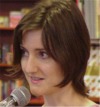
Lisa Twardowska, occasional theatre performer and
library and information-science specialist, then provided an exciting and
animated reading of “Ghosting the Sentence” (www.bywords.ca,
June 2004). The poem’s language and
images are simultaneously dazzling and disquieting, and the piece itself is
peppered with references to words and methods of articulation (“inevitable word
play,” “whispering a death, “tongue-caught,” and “master narrative”). “Weekends are for Driving” describes a
chaotic inferno, a nightmarish world of highway driving that ends “When this
neurotic ball of tension / unwinds in your loving arms.” The poet’s skill at manipulating words is
evident in the poem’s juxtaposed images of frenzied activity and ultimate
tranquility (which, one suspects, is only temporary).
At the beginning of Melissa Laveau’s second set, the
singer acknowledged with a smile that “all my songs are sad love songs.” When
she began singing the self-penned song that recognizes “It ends where it all
begins,” readers’ heads popped up from between the stacks at Chapters, and many
of them joined the group. Next followed
the disquieting “Paper Doll,” with its nuances of damnation and salvation: “I’ll
be your paper doll / rip me to shreds and watch me fall” – “You’ll be my
breaker . . . you’ll be my maker / you’ll be my mender.”
The next portion of the afternoon opened with a
reading by John Kehoe, poet and student of literature. His enigmatic “Elegy for Neruda’s Ode to Broken Things,” speaks of
poetry’s ability to articulate emotion when language fails, and to the
universality of the poet (the Neruda of the title could refer to Neftali
Ricardo Reyes Basoalto, the Chilean poet, or the nineteenth-century Czech poet
Jan Neruda). “Thistles and Dimes”
chronicles the pain of love, with the sorrowful lover providing the beloved
with the weapon -- the roses that wound.
Then, in a startling and humourous turnaround, Kehoe charted the
quintessential Canadian literary pilgrimage in “Two Rhodes Scholars Come to
Chapters.”

Anyone who lived in Ottawa in the winter of 1998
could identify with “The Ice Storm” (www.bywords.ca,
May 2004) written and performed by Ottawa educator Margaret Barclay. Even now, “the branches still bow under the
lightest / snowfall / or cellophane coating of ice.” Those descended from Celtic and northern European stock would be
particularly drawn to the poems under the rubric Orkney Reminders, and their allusions to the Vikings and Scots of
yore. While “Excarnation” evokes the
ancient, ecologically sound method of disposing of the dead, “Sticks and
Stones” features Viking graffiti that gives a voice to those long dead.

In “Snap Dragons,” Ottawa poet and short-fiction
writer Adele Graf counseled that even on the sweltering July day, sandwiched
between two full moons, the dampness and greyness of a November morning are not
far off. Graf’s touching tribute to
friendship, “Old Friends,” (dedicated to Marcia in the audience), reminded me
of my cherished friend who, like the friend of the poem, “recalls me young
decades ago.” Although the two friends
might not be related by blood, like siblings, they are “leaning and learning in
tandem.” Later, when Graf hugged her
“old friend” in the audience, it was a touching moment.
Melissa Laveau ended the event with “Wishful
Thinking,” which she promised was “actually not sad.” The aggressive lover, who promises “My love stings, but it don’t
bite” is in contrast to the “public clown” of “Drunken Verses,” who is mournful
at being rejected. The lovely “Haitian
Lullaby” ended the afternoon --- a stylized version, sung in Creole, that
Laveau’s mother used to sing.
Readers are reminded that www.bywords.ca now features an on-line store where they can purchase compact disks and back issues of their favourite events and poems. Also, Bywords next afternoon of music and poetry will take place on October 17, at 2 p.m. at Chapters on Rideau.
Catharine Carroll
Feast of Lughnasa, 2004
Postscript: Summer Wonder is the third event that I've covered for Bywords. I would like to take the opportunity to thank the participating musicians and poets who constantly reinforce Ottawa's reputation as a city filled with creativity. And, the selection team from Bywords, including Amanda Earl, Joe Goski, Stéphanie Lafleur, Sarah Ruffolo, Betty Warrington-Kearsley and Christine Zadorozny, always ensures that the talent is there. Finally, I want to thank Charles Earl, location manager and photographer, for the superb pictures that grace this article.